William White, former economist at the the Bank for International Settlements in Basel, a joint organization of all the world's central banks, who predicted the 2007 financial crisis before it happened, is again at the forefront of controversial predictions.
Although White retired from the BIS at age 65, he continued his career at another prestigious organization. This Canadian native is now chairman of the Economic and Development Review Committee at the OECD, an international economic organization of 34 countries. At the annual "happy, go very lucky" get-together at the World Economic Forum in Davos, he was interviewed by the British The Telegraph, and this is what he told The Telegraph's international editor, Ambrose Evans-Pritchard:
"The situation is worse than it was in 2007. Our macroeconomic ammunition to fight downturns is essentially all used up...
" Debts have continued to build up over the last eight years and they have reached such levels in every part of the world that they have become a potent cause for mischief...
Thursday, January 21, 2016
Monday, July 27, 2015
Grieks foutenfestival: van 600 miljoen Euro voor Goldman Sachs tot alexithymie van Europese leiders
![]() |
| "Exodus uit Messolonghi" door Theodore Vryzakis (1853) |
Ik zit in een “diner” in New York. “Diners”, een soort goedkope
Amerikaanse eetcafes, worden in New York grotendeels gerund door Grieken, velen
aangekomen na de Tweede Wereld Oorlog en na de Griekse burgeroorlog van
1946-1949. Zo’n 20.000 Grieken wonen nu voornamelijk in de wijk Astoria, ten
oosten van Manhattan aan de overkant van de East rivier gelegen. In Astoria zie je nog steeds veel Griekse
winkels, cafes, restaurants, en Grieks Orthodoxe kerken en als je de Griekse
tongval op straat hoort, waan je je, zeker in de zomer, even in het verre
Griekenland.
Terwijl mijn ogen over de menukaart glijden, moet ik denken
aan de vele stigma’s die de afgelopen tijd over Grieken zijn geuit in de Europese
en ook Amerikaanse media: Grieken zijn lui, corrupt en geven geld uit als water.
Nou zit er een kern van waarheid in als je kijkt naar de Griekse regeringen en
de oligarchen, maar geldt dat ook voor de gemiddelde burger? Mijn ervaring met Griekse “diners” laat een
ander beeld zien: drukdoende en hardwerkende Griekse uitbaters
en obers, velen die lange dagen werken, aangezien diners vaak 24 uur per dag
open zijn, iets wat je niet snel zal zien in het efficiente Duitsland of
Nederland.
Toch, Griekenland is meer dan die oppervlakkige
waarnemingen. Griekenland is niet alleen bakermat van de Westerse beschaving of
goedkoop vakantieland. Griekenland heeft een turbulente geschiedenis achter de
rug: vanaf de 15e eeuw driehonderd jaar
overheerst door het Ottomaanse rijk. Een
zwaarbevochten Duitse bezetting in de Tweede Wereldoorlog, gevolgd door een
splijtende burgeroorlog, met o.m. betrokkenheid van Groot Brittanie en de VS. Een militaire dictatuur van 1967 tot 1975.
Daarna tot 2015 regeringen die geleid werden door de socialistische PASOK
partij of de conservatieve Nieuwe Democratie partij, beide partijen verweven
met de corrumperende oligarchie in het land, en in die zin alle drie
verantwoordelijk voor de vele problemen die Griekenland plagen. Kortom niet een
land, waar simpele clichés op hun plaats zijn.
Hoe het Grieks drama ook afloopt, nu al staat vast dat
niet alleen de goede naam van de Grieken is beschadigd, maar ook de fundamenten
van de Europese Unie, zoals economische
samenwerking, politieke integratie en zelfs democratie. Zoals ik hieronder in vogelvlucht
zal schetsen is dit niet alleen veroorzaakt door de Grieken, maar door een patroon
van Euro-politici die gedurende meer dan twintig jaar forse inschattingsfouten
hebben gemaakt. Uiteindelijk zal heel
Europa hieronder lijden.

Labels:
alexithymie,
Astoria,
Dijsselbloem,
Diner,
EMU,
EU,
Goldman Sachs,
Grexit,
Griekenland,
Griekse salade,
Grillo,
IMF,
Kohl,
Lagarde,
Maastricht,
Mitterand,
Olympische Spelen,
Ottomaanse rijk,
PASOK,
Schauble
Tuesday, June 9, 2015
American Pharoa: Finally a Triple Crown Winner
![]() |
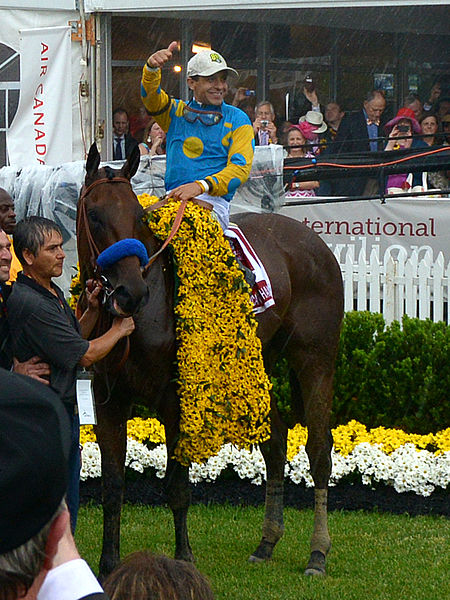
| American Pharoa at 2015 Preakness Stakes (Commons Wikimedia) |
American Pharoa won the Belmont Stakes in New York, the third race of a three race series, the Triple Crown, a title awarded to a three-year-old Thoroughbred horse who wins the Kentucky Derby, Preakness Stakes, and Belmont Stakes.
According to Wikipedia, the first winner of all three Triple Crown races was Sir Barton in 1919. Till 2015, only eleven illustrious horses had won the Triple Crown, including Sir Barton: Gallant Fox (1930), Omaha (1935), War Admiral (1937), Whirlaway (1941), Count Fleet (1943), Assault (1946), Citation (1948), Secretariat (1973), Seattle Slew (1977), and Affirmed (1978.)
In recent years many top racehorses were close by winning 2 of the 3 major races, but failed to win the third, such as California Chrome (2014), Big Brown (2008), Afleet Alex (2005), Smarty Jones (2004), Funny Cide (2003), War Emblem (2001) and Point Given (2000.)
But this year the American racing sport and its many fans got a shot in the arm, when American Pharoa,
Friday, April 24, 2015
100th Anniversary of Armenian Massacres or Genocide?
![]() |
Armenian Prisoners, Kharper, Armenia, Ottoman Empire
April, 1915 (Wikimedia)
|
Today marks the day that hundred years ago, over 1.5 million Armenians were killed by the Ottoman Empire. According to most historians this was a genocide, i.e. the systematic destruction of all or a significant part of a racial, ethnic, religious or national group - according to Wikipedia, which lists as examples of genocides, the Holocaust, the Rwandan and Bosnian Genocides, and the Armenian Genocide. Turkey, however, does not want to call this tragic episode a genocide. What do eyewitnesses say? The Washington Post's article "Is this genocide? What four Americans saw happening to Armenians 100 years ago" presents quotes from a recent book Great Catastrophe: Armenians and Turks in the Shadow of Genocide by Thomas de Waal, an expert on the South Caucasus region. One quote is from then U.S. Ambassador to the Ottoman Empire, Henry Morgenthau in a cable sent to Secretary of State Robert Lansing on July 10, 1915:
"Persecution of Armenians assuming unprecedented proportions. Reports from widely scattered districts indicate systematic attempts to uproot peaceful Armenian populations and through arbitrary arrests, terrible tortures, wholesale expulsions and deportations from one end of the Empire to the other accompanied by frequent instances of rape, pillage, and murder, turning into massacre, to bring destruction and destitution on them. These measures are not in response to popular or fanatical demand but are purely arbitrary and directed from Constantinople in the name of military necessity, often in districts where no military operations are likely to take place."
Morgenthau went on, explaining the shocking reasons behind the violence:
Thursday, April 9, 2015
Danny Schechter (1942-2015), Journalist, Filmmaker, Author and Activist

It's with deep sadness that I have to announce that Danny Schechter, journalist, filmmaker, television producer, author and friend died on March 19, 2015 after a battle with cancer. Danny Schechter was a unique personality, in person and professionally. His media background started in the 1970s on the radio as "The News Dissector" at WBCN-FM in Boston, where he informed his listeners about the news infused with his typical sense of humor. In 1980, he joined CNN, the cable news network that just had been founded by Ted Turner, and later on he was a producer with the ABC News magazine 20/20, where he won two Emmy Awards. Independent-minded as he was, in 1988 he co-founded the production company Global Vision together with Rory O'Connor, where they produced many documentaries, including "South Africa Now", an award winning public television series.
Danny's passion always was on the crossroads of media and human rights: he reported on how the mass media informed or rather misinformed on many topics. He had maintained that the media were critical to a well-run democracy, but over the years realized that the media were no longer a solution to the problems in the world, but part of the problem. Danny also covered some of the major issues of our times: from the struggle against apartheid in South Africa and the civil war in Bosnia, to civil rights in the U.S., the debt crisis in this century with his film "In Debt We Trust: America before the Bubble Burst" and the Occupy Wall Street movement.
Danny Schechter was not only a radio host and filmmaker, but also an active blogger and author of 17 books. Among his books, he released the following
Thursday, February 5, 2015
The Changing Role of Publishers
Every day there are new views and discussions
about the changing role of publishing, While browsing for the latest
developments, I found this August, 2014 article "Authors should back Amazon in the battle with Hachette" by John Kay in The Financial Times.
Kay's article is about change, the value of publishers and the
strengthened role of authors. He describes the ebook controversy between
Amazon and Hachette, which last summer was still unresolved after
months of negotiations, - see also my June, 2014 blog post The Amazon - Hachette Saga -and he disagrees with a group of leading
Hachette authors who wrote an open letter
intervening in that dispute. Kay believes the authors should understand
that they are benefiting from Amazon's technology and distribution
capabilities. Although the dispute between Hachette and Amazon has been
resolved (see this November article in The New York Times,) Kay
makes some worthwhile points. In his view it's all about change and how
publishers and authors - and readers for that matter - deal with this
ongoing change in the publishing landscape. He states (underlining added
by undersigned):
"....Established companies in all industries are inhibited in their response to radical change by vested interests inherent in their existing business models. Music publishers tried to block new technologies, and were marginalised by better-run businesses: Apple, Walmart and Spotify. Book publishers responded initially with dismal reproductions on screen of their printed books. When these failed to sell, they retired into protecting the status quo...........
....The role of the book publisher has been based on control of access to channels of distribution. The ambition of the aspirant author has always been to “get published”. Along with the decision as to what should be published, the company has traditionally provided a collection of associated services: identification, support and finance of the underlying literary project, editing of the draft manuscript, and marketing and promotion of the finished work. But the large conglomerates that have come to dominate publishing are run by people who love money more than they love books. These support-activities have been cut back in the interest of maximising the revenue, from control of access to distribution. "
Kay continues by saying:
Tuesday, December 23, 2014
Einstein and How Society is Going Crazy
![]() |
| Einstein, Vienna 1921./Albert-Einstein-Archiv, |
Although it's doubtful that Einstein actually made this statement,
"...I fear the day that technology will surpass our human interaction. The world will have a generation of idiots....",
whoever did say this, I fully sympathize with the meaning and how it applies to so many of us who seem unable to "live" without their smartphones.
Subscribe to:
Posts (Atom)