Showing posts with label Bill Moyers. Show all posts

Thursday, October 3, 2013

Greenpeace, Climate Change and the Future of Humanity

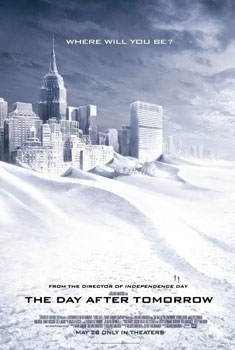
The Day After Tomorrow/Twentieth Century Fox Film Corp.
In my recent post, Climate Change and Tipping Points, I referred to organizations and individuals who step up to the plate to protect the planet  from climate change - as governments are dragging their feet and many business have apparent opposing interests -. One such an organization is Greenpeace and one such an individual is its International Executive Director, South African Kumi Naidoo.

Naido was recently interviewed by Bill Moyers on his TV program Moyers & Company. In this wide ranging interview, Naidoo talks about the Greenpeace ship, the Dutch registered Arctic Sunrise, which last month, while taking action against the Prirazlomnaya oil rig - where Gazprom intends to become the first company to pump oil from icy Arctic waters - was stopped by Russian special forces. They arrested the 30 people on board of that ship, who are now being charged with piracy, and face potentially many years in prison.

Naidoo also discusses the "insanity" of drilling in the Arctic; how history will judge the current leadership of governments and big businesses harshly due to their lack of action towards climate change; the question whether it's too late to counter climate change; that the world is playing political poker with the future of our planet; that we should write-off 80% of the current fossil fuel reserves and start an energy revolution; Greenpeace's partnership with Facebook and how internet companies will see a fourfold increase of their energy use in the coming years; and how....


Thursday, July 18, 2013

Why Don't Americans Follow the Brazilians on the Barricades?

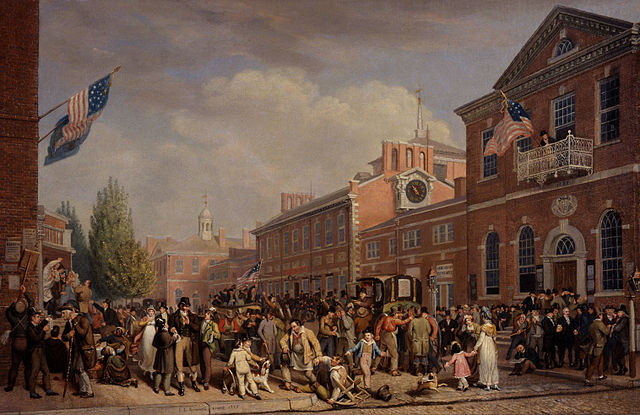
Election Day by John Lewis Krimmel 1815
Marty Kaplan,  Professor of Media, Entertainment and Society  and the founding director of the Norman Lear Center for the study of the impact of entertainment on society, at the
USC Annenberg School for Communication & Journalism recently wrote an article Let's Be Brazil  in the Huffington Post about last month's massive protests in Brazil, and was wondering why Brazilians went to the streets and why it seems nearly impossible within the U.S.  to organize similar protests "even though millions of Americans below the poverty line can't make a living wage, and millions more are barely hanging on by their fingernails." Kaplan continues:

"..There are, of course, plenty of dissimilarities between the U.S. and Brazil, a developing nation ruled by military dictatorship until 1985, but there are also plenty of all-too-close analogies between what's pissing off Brazilians and what ought to piss off Americans.
  • Income inequality. Brazil is in the world's bottom 10 percent on income inequality, ranking 121st out of 133 countries. But the U.S. ranks 80th, just below Sri Lanka, Mauritania and Nicaragua.
  • Wealth distribution. There are only six countries in the world whose wealth distribution -- accumulated holdings, not annual funds earned -- is more unequal than Brazil. But the U.S. is one of those six.
  • Education. The annual rate of growth in student achievement in math, reading and science in Brazil is 4 percent of a standard deviation. But U.S. educational achievement is growing at less than half that rate: 1.6 percent, just below Iran.
  • Corruption. Brazil ranks 121 in public trust in the ethical standards of politicians, out of 144 countries. But the U.S. comes in only at 54, just above Gabon.
  • Infrastructure. The quality of Brazil's infrastructure puts it at a dismal 107, out of 144 countries. But the U.S. ranks 25th -- below most other advanced industrial countries and even behind some developing nations, like Oman and Barbados.
  • Health care. Brazil's health care system ranks 125th out of 190 countries. But the U.S., jingoistic rhetoric notwithstanding, is only 38th. Among our peer nations -- wealthy democracies -- we're dead last, and it's only gotten worse over the past several decades.
So why aren't Americans at the barricades?

Tuesday, February 26, 2013

Minimum Wage and Capitalism Run Wild


Serge Melki/Wikimedia Commons
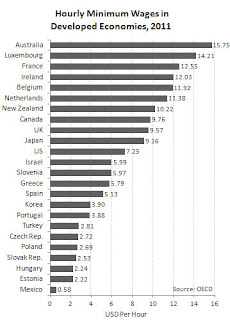
President Obama proposed an increase in the U.S. minimum wage from $7.25 to $9.00 in his State of the Union address. As usual, pundits from left and right criticized this as not enough or too much. Also, economists around the world continue to debate whether a high minimum wage can support or hamper economic growth and development.  Internationally, the following OECD diagram shows minimum wages in a number of countries, for example Australia seems the most generous at $15.75 per hour; the Netherlands offers $11.38, Mexico at the bottom with $0.58 and the U.S. as already stated, with a $7.25 minimum wage.

OECD Statistics
Obviously there are many differences, economically and culturally between these countries, so let's go back to the situation in the U.S. Maybe the situation with minimum wages is not just about the minimum wage but symptomatic for bigger issues in the economy as a whole. Economist Dean Baker explains this proposed increase in an article in the Huffington Post Minimum Wage: Who Decided Workers Should Fall Behind?  He states: