Thursday, March 14, 2013

Investment Strategist Jeremy Grantham on Debt, Paper World vs. Real World

TaxCredit/Flickr
Jeremy Grantham, Co-founder and Chief Investment Strategist of Grantham Mayo Van Otterloo (GMO) an asset management firm, and known for his predictions and views of  market bubbles was this week interviewed on the Charlie Rose show. Grantham covers a whole range of subjects related to the economy and financial markets. One of the things he mentioned, which I found remarkable, was that debt is not the main problem facing the U.S. and the world economies. Debt is part of the paper world, he says. More important is the real world, which is, in his view about the quality of people, their education and training and the innovation of products and equipment.


Other areas he touches upon are the dangers of the Keystone pipeline for the environment; the importance of renewable energies in order to move away from the current carbon driven society; that the housing market collapse and the price increase of commodities are the main reasons for the current economic crisis, more so than the debt crisis; how the shortage of fertilizer and specifically the finiteness of phosphorus could cause a food disaster within the next 50 years;  and how current monetary policies are transferring wealth from the poor (i.e. savers and pensioners) to the rich (i.e. hedgefund managers and banks.) For the complete interview click here.
 

Tuesday, March 12, 2013

Whole Foods Announces GMO Labeling

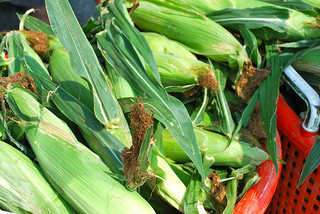
Sweet corn/Fairfax County
While the democratic process in the U.S. is slow in deciding on mandatory GMO labeling, being hampered by several corporate interests, it's now another corporation which shows the way to a safer future for consumers. Whole Foods supermarket, as America's first national grocery store, has decided that by 2018 products in its U.S. and Canada stores must be labeled if they contain genetically modified organisms.

As Walter Tobb, co-CEO of Whole Foods, stated in The Huffington Post:

“We are putting a stake in the ground on GMO labeling to support the consumer’s right to know. The prevalence of GMOs in the U.S. paired with nonexistent mandatory labeling makes it very difficult for retailers to source non-GMO options and for consumers to choose non-GMO products. Accordingly, we are stepping up our support of certified organic agriculture, where GMOs are not allowed, and we are working together with our supplier partners to grow our non-GMO supply chain to ensure we can continue to provide these choices in the future.”

This news follows on the heels of a recent HuffPost/YouGov poll indicating that 82 percent of Americans think GMO foods should be labeled. Common sense still would dictate that the labeling of GMO should happen as soon as possible. Although Wholefoods' initiative is welcome, waiting five years seems a long time when dealing with consumers' choice and health.  

Detroit, a Microcosm of America?

Ian Ransley Design/Flickr
 “Detroit is a microcosm of what’s going on in America, except America can still print money and borrow,” said Mr. Boyle, a veteran financial consultant after reviewing the financials of the city of Detroit. Is Mr. Boyle right and what does this mean for the future of American cities? Read full article in the New York Times about how Detroit seems to be stumbling towards bankruptcy.  For a visual experience see the ruins of Detroit.

Friday, March 8, 2013

Wealth Inequality in America


Serge Melki/Wikimedia Commons
We know that wealth inequality has been increasing in the U.S. - and in many other countries - : stories about CEOs making hundreds of times more than their average employees; bonuses of millions of dollars awarded to executives who leave, stay, sign up, perform well, perform ok, or perform lousy while average pay is under pressure; individual hedge fund managers making billions a year, while countries are on the verge of bankruptcy for lesser amounts. I discussed this subject in a previous post, Money, Power & the American Dream. Books have been written, studies performed about the negative consequences of too great of an inequality, but political discussion or social outrage has been quite limited in the U.S., with the exception of the Occupy Wall Street movement. Till now, perhaps, with the following video which has been going viral. It gives a simple but clear overview of wealth inequality in the U.S., showing that the gap between the haves and have-nots is much worse than many of us think:


Tuesday, March 5, 2013

Are There Any Europeans Left?

(European Politicians, Robin Hood Tax/Flickr)
While being this week in Europe, I couldn't help reading the most international newspaper of Europe, The International Herald Tribune. Soon it will be renamed the International New York Times, which is too bad but a sign of the times - no pun intended - and reflects the reality of being solely owned by The New York Times. The International Herald Tribune used to be a joint-venture between the Times and The Washington Post, but the Post stepped out in 2003, so now The New York Times wants to extend its global branding: see for a personal memory Adieu Herald Tribune by Hendrik Hertzberg of the New Yorker. Anyway, coming back to where I began: I was reading a thought-provoking article by French writer and journalist Olivier Guez, titled: Are there any Europeans left?

It starts out by saying that Europe is in a crisis "not just of Europe’s currency, but of its soul." and he continues:
 

Tuesday, February 26, 2013

Minimum Wage and Capitalism Run Wild


Serge Melki/Wikimedia Commons
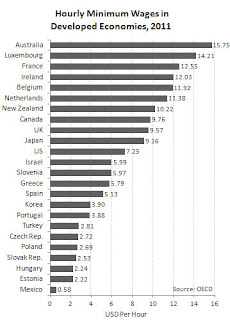
President Obama proposed an increase in the U.S. minimum wage from $7.25 to $9.00 in his State of the Union address. As usual, pundits from left and right criticized this as not enough or too much. Also, economists around the world continue to debate whether a high minimum wage can support or hamper economic growth and development.  Internationally, the following OECD diagram shows minimum wages in a number of countries, for example Australia seems the most generous at $15.75 per hour; the Netherlands offers $11.38, Mexico at the bottom with $0.58 and the U.S. as already stated, with a $7.25 minimum wage.

OECD Statistics
Obviously there are many differences, economically and culturally between these countries, so let's go back to the situation in the U.S. Maybe the situation with minimum wages is not just about the minimum wage but symptomatic for bigger issues in the economy as a whole. Economist Dean Baker explains this proposed increase in an article in the Huffington Post Minimum Wage: Who Decided Workers Should Fall Behind?  He states:


Thursday, February 14, 2013

Hawaii Vote: Another Strike in the Battle Against GMOs

Sweet corn/Fairfax County
Food activists in Hawaii won a partial victory last week when the House Committee on Agriculture passed a measure to require labeling on genetically modified food. This seems only a partial win as Common Dreams reports:
"...Originally, House Bill 174 required any food product that is produced or sold in Hawaii to have a label saying it contains or was made using genetically engineered materials, but (last) Thursday's committee hearing amended the requirements so it only applies to produce imported from outside Hawaii...

..... Despite this provision, Hawaii is a ripe battleground for new legislation. According to the anti-GMO organization Hawai'i Seed, "Hawaii is the genetic engineering experimental capital of the world," with thousands of acres of arable farmland being used to test seed crops for agriculture giants, including Monsanto." In other words........